How to Build a Custom Women's Studio-to-Life Matching Set Capsule for Private Label Activewear Brands
- Share
- Issue Time
- Apr 12,2026
Summary
This article explains how growing and private label activewear brands can build a studio-to-life matching set capsule with clearer product roles, balanced support, coordinated fabric logic, and more efficient early-stage development. It covers core piece planning, sample priorities, common mistakes, and why an ODM-led start often works better for first matching set projects.

Studio-to-life matching sets work best when each piece is designed to play a coordinated role inside
the same wearable system. For growing women’s activewear brands, the strongest first capsule usually
comes not from making every piece identical, but from aligning support, silhouette, fabric function,
and styling flexibility around one clear set direction.
For many growing activewear brands, the biggest collection problem is not a lack of ideas.
It is a lack of coordination.
A sports bra may look promising. A pair of leggings may feel commercially safe.
A light layer may seem like a useful add-on. But once those pieces are placed together,
the collection can still feel fragmented instead of intentional.
That is where a studio-to-life set direction becomes commercially useful.
The goal is not to make every piece feel the same. The goal is to make every piece play
the right role inside the same set system — so the capsule feels coordinated in wear,
not just coordinated in color.
For many Australian-facing women’s activewear brands, the strongest commercial signal is no longer
pure gym-only performance. The demand is increasingly for activewear that can move between
light training, studio sessions, commuting, travel, and low-friction daily wear.
That is exactly why a
matching set collection direction
matters: it gives brands a clearer way to balance movement, comfort, and all-day styling relevance
inside one capsule.
This direction is especially effective for growing brands that want their first or next capsule
to feel clear, wearable, and easier to merchandise.
It works particularly well for labels that already know they want coordinated bras, leggings,
shorts, or light layers — but still need
ODM development support
to shape the final piece mix, support balance, or fabric roles.
It is less effective for brands whose first priority is high-impact training performance across
every SKU, because that usually requires a different support and fabric logic from the start.
hucai sportswear can help brands clarify core bra-bottom direction, fabric roles, and first-sample priorities before the capsule becomes too wide or inconsistent. Matching sets usually need more than styling coordination. Support balance, sample order, fabric behavior, and production consistency all need to be aligned early. hucai sportswear can work with different fabric roles inside the same set system, so tops, bottoms, and layers stay visually coordinated without forcing identical construction.
Random single-style development usually weakens the collection story.
A bra may feel studio-friendly, but the leggings may lean technical,
while the outer layer may belong to a completely different mood.
The products still exist, but the collection no longer feels unified.
Studio-to-life matching sets solve that problem by giving the brand a clearer internal structure.
Instead of asking, “What else should we add?” the better question becomes,
“What belongs inside this set system?”
A matching set should be treated as a system, not as a group of visually related SKUs.
Once brands start planning by role instead of by isolated style,
decisions around bras, bottoms, layers, support, and fabric choices become much clearer.
That matters commercially. A stronger set logic usually makes the product line easier to understand,
easier to merchandise, and easier to extend into new colors, layers, and follow-up capsule drops.
For many private label and custom activewear projects, the first challenge is not how many styles
to launch, but which pieces should anchor the matching set capsule from the start.
In most cases, the answer starts with a bra and a bottom. From there, the capsule can be extended
with a lighter seasonal option, a more lifestyle-facing silhouette, or a soft layer that still belongs
to the same set story.
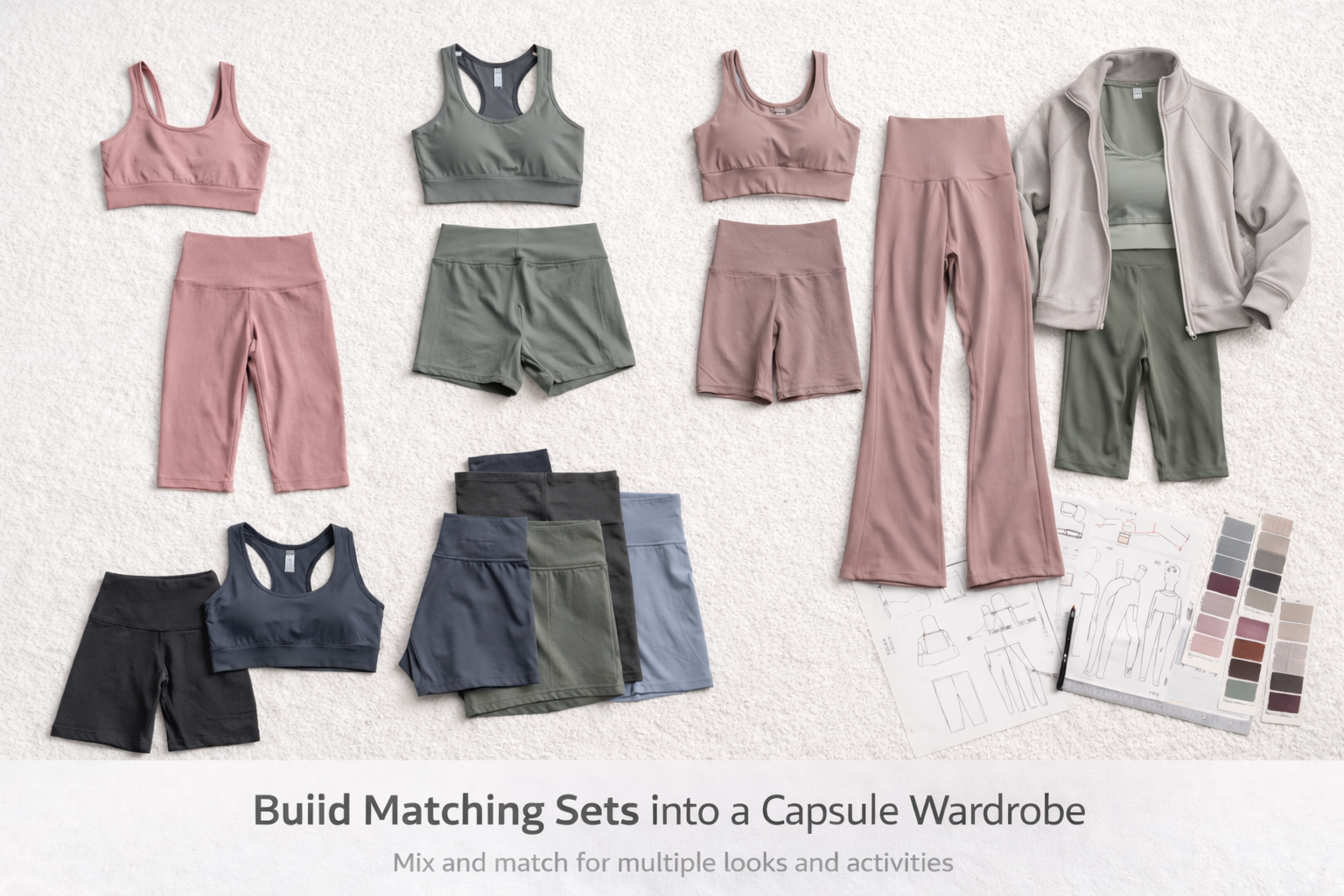
This is often the cleanest place to start. It gives the collection a stable shape and makes it easier
to define the overall mood. In many cases, better
sports bra development
decisions around neckline, underband feel, and strap proportion do more for the set than adding
extra visual details.
This is usually the most versatile commercial core. It gives enough hold for movement while staying
wearable enough for longer use. For many growing brands, this becomes the set that best represents
“studio-to-life” rather than either extreme of softness or high-intensity compression.
A flare or softer silhouette can shift the capsule toward a more all-day and lifestyle-facing direction.
Used well, it adds variety without breaking the set language. This is where a clearer
custom leggings direction
becomes important, because the bottom silhouette often decides whether the set reads as studio,
athleisure, or performance-heavy.
Bike shorts can make the capsule feel lighter, more seasonal, and easier to extend into warm-weather edits.
They are often useful as a secondary set direction, not necessarily the first anchor SKU.
This is where the capsule becomes more complete. A fitted top, soft jacket, or lightweight cover layer
can help the collection move beyond the studio and feel more adaptable.
But the layer must still belong to the same wearing logic — not just be added because it “matches.”
One of the most common mistakes in matching set planning is treating support as a separate technical detail.
In reality, support level is part of the set story.
If the bra is built around a highly technical, high-impact logic, but the leggings and layer are built
around softness and all-day wear, the collection starts to feel internally split.
The pieces may still match visually, but they stop behaving like one system.
A simple warning sign is this: if the bra feels built for high-impact control while the leggings
and outer layer feel built for softness and all-day ease, the set may still match visually,
but it will no longer behave like one product story.
That is one reason some brands should keep this direction distinct from a more
higher-support training set direction.
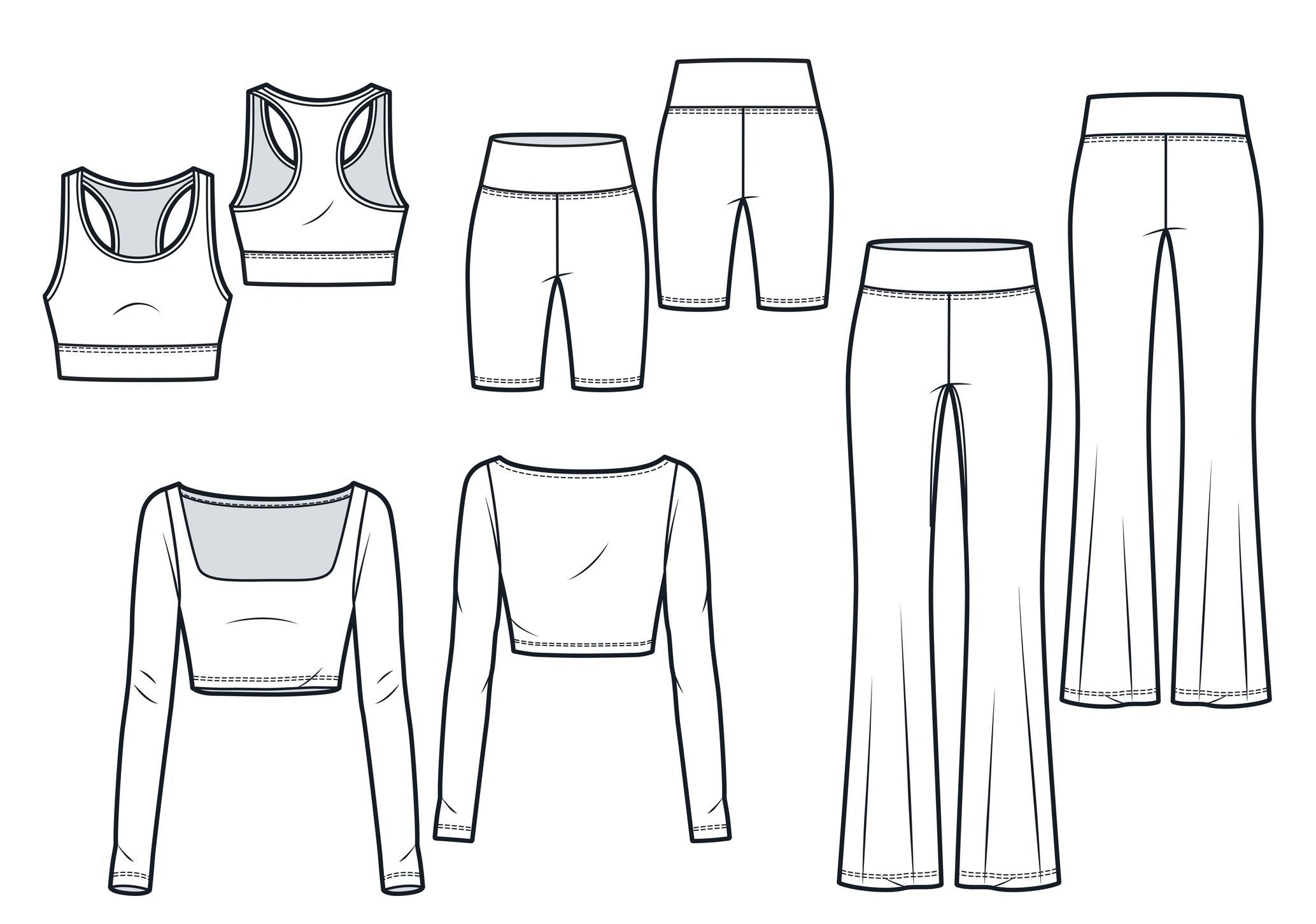
Before the first sample round, the brand should not only confirm silhouettes.
It should confirm the full set logic.
Core bra-bottom direction, support target, and the role of each main fabric. Secondary silhouette extensions, exact layer style, and part of the seasonal color expansion. Trying to sample too many SKUs too early, or forcing identical fabric logic across tops, bottoms, and layers.
A strong matching set does not always use one fabric everywhere.
In many cases, the best result comes from one base fabric for the core visual language,
a more supportive fabric logic where hold matters more, and a lighter construction where
layering needs to stay easy and breathable.
This is also the right stage to review
fabric selection guidance
more closely. If the brand wants a more premium or market-aware direction, it is worth deciding early
whether recycled or more sustainability-oriented fabric options should be part of the capsule logic.
Not every piece should be sampled first. For many brands, the most efficient path is to define
one core bra and one core bottom before extending into additional silhouettes.
That usually reduces unnecessary revisions and makes the first set more coherent.
If MOQ pressure or development budget is a concern, do not spread the project too wide in the first round.
A tighter 3–5 SKU capsule often leads to a stronger launch than trying to force too many bras,
bottoms, and layers into the same first sample cycle.
For brands shaping an early set direction, one of the first real anxieties is timing:
how quickly can the first samples be reviewed, and when do MOQ and bulk decisions need to be fixed?
In practice, it is usually more efficient to lock the core bra-bottom direction first,
then confirm fabric roles, color logic, and approval priorities before expanding the capsule.
If you already have reference images or a general direction but still need help locking
fabric roles, support balance, and first-sample priorities, this is usually the best stage
to clarify the system before development spreads too wide.
Not sure whether to lock bras first, bottoms first, or fabric first?
Start with the matching set direction page, then move into ODM support once the capsule logic is clearer.
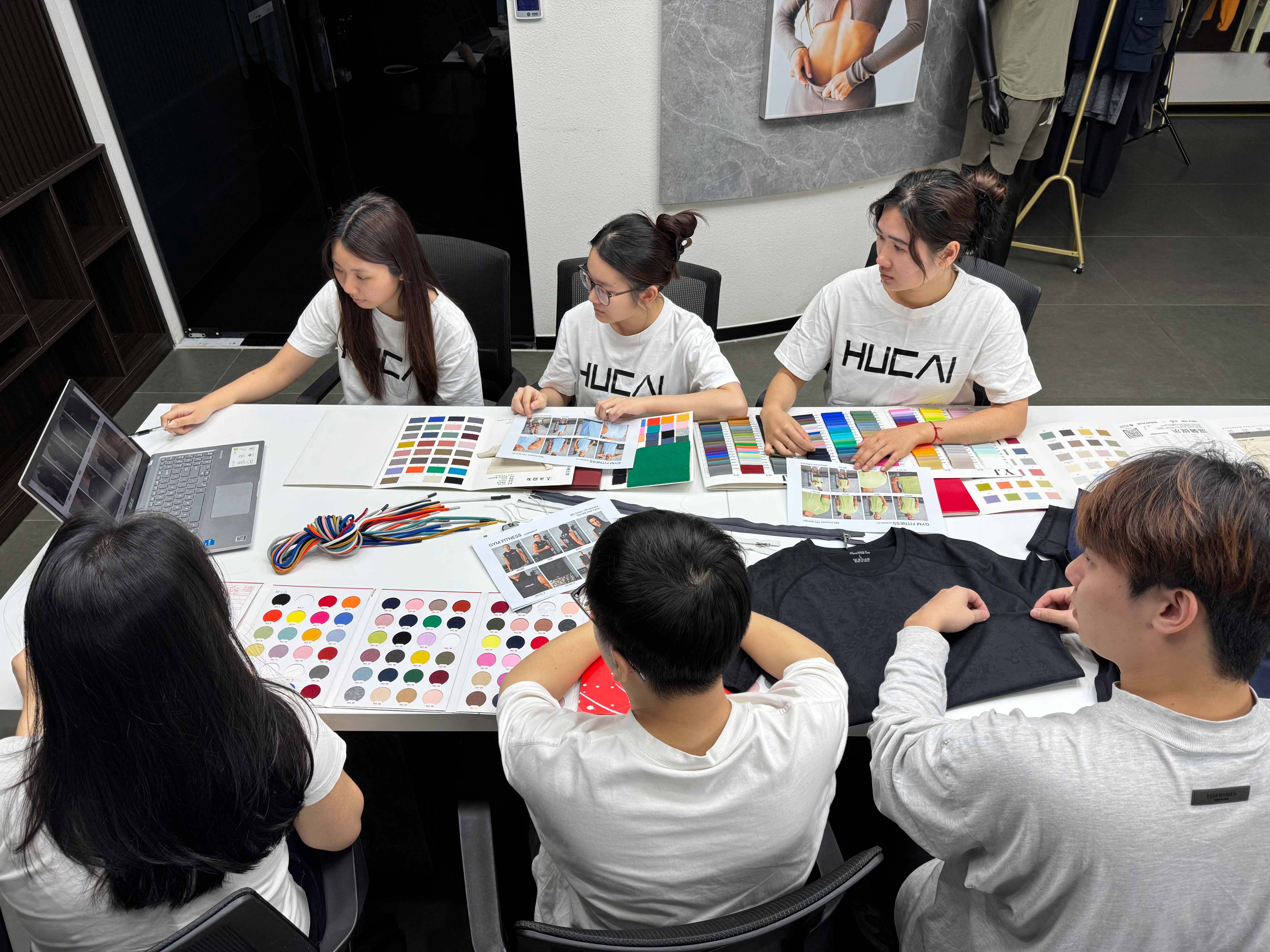
Studio-to-life matching sets often work best when the early stage stays ODM-led.
That is especially true when the brand still has reference images, broad style direction,
and a general product idea — but not a fully locked tech pack package for every piece.
In that stage, the real challenge is not simply manufacturing. It is coordination.
Which bra should lead? Which bottom should define the set? Which layer actually extends the capsule
instead of diluting it?
That is exactly where
ODM support for matching set development
becomes more valuable than rushing into a fixed OEM-style execution path too early.
An ODM-led start can help clarify fabric hierarchy, support balance, piece order, and set identity
before the project becomes overloaded with revisions.
For brands still shaping their first custom women’s matching set, this usually leads to fewer avoidable
revisions, a clearer MOQ discussion, and a more commercially stable first launch.
MOQ usually depends on the final capsule structure, fabric choice, and how many core pieces are being
confirmed in the first round. For matching set projects, it is often more useful to lock the bra-bottom
direction and sample priorities first, then move into MOQ discussion once the set logic is clearer.
The first sample round usually depends on how clearly the core set direction has been defined.
If the brand has already locked the main bra-bottom combination, support target, and fabric roles,
development is usually more efficient. If too many silhouettes stay open at the same time,
the first round often takes longer and leads to more revisions.
Yes. Many early-stage matching set projects begin with references, silhouette ideas,
and a general product direction rather than fully locked tech packs.
That is often where ODM support is most useful.
If the brand already has complete tech packs and a fully fixed set structure, OEM can work well.
If the direction is still being shaped — especially around support, fabrics, layering, or SKU scope —
ODM is usually the better first step.
In most cases, it is more efficient to start with the core bra and one key bottom.
Those pieces usually define the support logic, silhouette language, and set identity
for the rest of the capsule.
No. Many strong matching sets work better when different fabrics play different roles.
What matters more is that the handfeel, color presentation, and product logic stay coordinated
across the full set.
The key is not forcing identical construction. It is aligning yarn direction,
color development, handfeel expectations, and the role of each fabric so the set reads
as one system.
Before MOQ and bulk decisions are fixed, brands usually need to lock the core bra-bottom direction,
fabric roles, support target, and first sample priorities. Otherwise the discussion becomes
commercially unclear too early.
A studio-to-life matching set collection is not just a styling trend.
For many growing women’s activewear brands, it is a smarter way to build a first clear capsule.
The brands that do this well are not simply matching colors across SKUs.
They are building coordinated product roles that make the set easier to wear,
easier to merchandise, and easier to scale.
The real goal is not to make every piece identical.
The goal is to make every piece belong to the same wearable system.
For private label and custom women's activewear brands, a matching set capsule often works better when product roles are coordinated early. A practical guide for growing brands that want matching sets to feel commercially clear,
wearable, and coordinated by role — not just visually matched.
Quick Answer
Who This Direction Is Best For
Why This Direction Works Better Than Random Single Styles
What Pieces Make a Studio-to-Life Matching Set Capsule Commercially Clear
1. Soft or Easy-Entry Bra + Leggings
2. Medium-Support Bra + Leggings
3. Flare Leggings or Lifestyle-Led Bottom Variation
4. Bike Shorts Set
5. Bra + Bottom + Light Layer
Support Level Should Match the Set Story
What Brands Should Confirm Before Sampling
Decision Check Before First Sampling
Confirm the fabric roles
Confirm the sample order
Confirm the first capsule scope
Confirm the sample and approval rhythm
Planning Your First 3–5 SKU Matching Set Capsule?
Why This Path Often Works Better as an ODM-Led Start
FAQ
1. What is the MOQ for a custom women’s matching set?
2. How long does the first sample round take for a matching set project?
3. Can you help if we only have reference images, not full tech packs?
4. Is this direction better for OEM or ODM?
5. Which piece should be sampled first in a studio-to-life set?
6. Do all pieces in a matching set need to use the same fabric?
7. How do you keep a matching set visually coordinated if different fabrics are used?
8. What should be confirmed before discussing MOQ and bulk planning?
Final Takeaway