What Really Limits Production Capacity in Women's Sportswear Manufacturing
- Share
- publisher
- 然
- Issue Time
- Mar 27,2026
Summary
Production capacity in sportswear manufacturing depends on work content, fabric behavior, and operator skill, requiring strong system control for consistent activewear output.
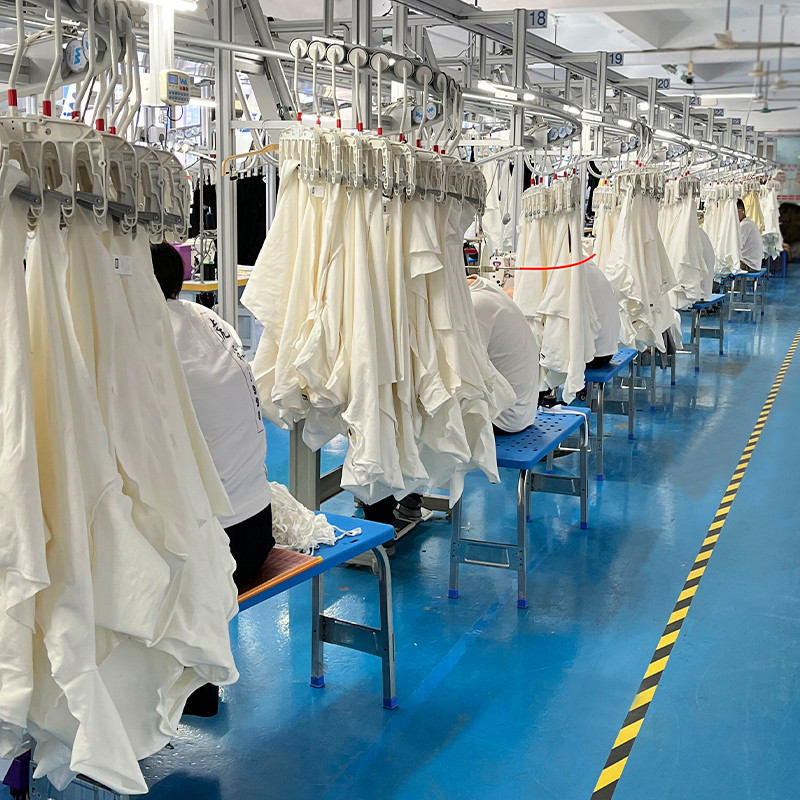
When people talk about production capacity in a garment factory , they usually think about the number of sewing machines or the size of the workshop. In reality, capacity is constrained by a tighter set of variables: how evenly work is distributed across the line, how the fabric behaves under cutting and sewing, how much time is lost in style changeovers, how many operations are built into each garment, and how quickly operators can reach stable performance. In apparel research, line balancing, setup reduction, work measurement, and operator learning all show up as recurring causes of capacity loss because the factory only runs as fast as its slowest unstable point.
Line Balance Is a Physics Problem Before It Is a Staffing Problem
In garment manufacturing , output is not determined by the average speed of a line. It is determined by the operation that cannot keep pace with the rest. That is exactly why industrial engineers in apparel plants use stopwatch studies and standard allowed minutes: once one station drifts above the rest, work-in-process accumulates in front of it, while downstream operators wait idle. This is the basic mechanics behind a bottleneck.
A pair of leggings is a good example. In an illustrative engineering benchmark, one piece may move through cutting, panel matching, crotch/gusset joining, inseam closing, outseam closing, waistband attachment, hemming, and final trimming/inspection. A workable benchmark might look like this: cutting and numbering at 0.52 min/piece, gusset joining at 0.38 min, inseam and outseam at 1.05 min combined, waistband joining and elastic control at 0.95 min, hemming at 0.42 min, and final trim/inspection at 0.18 min, for a direct content of roughly 3.50 min per piece. Those are not universal SAM values; they are a practical model for understanding balance.
The line stops feeling “balanced” the moment one station moves far above the others. In leggings, the problem often appears at the waistband station. If the cutting department delivers waistband strips with inconsistent width, the folding attachment in sewing has to be readjusted continuously. If needle-thread tension is not tuned for a high-stretch waistband seam, the operator slows down to avoid skipped stitches. If pre-joined waist elastic varies in length, the same operator spends extra seconds correcting tension by hand. Suddenly that 0.95-minute operation becomes 1.30–1.40 minutes. The bottleneck is no longer “the sewing line” in general; it is specifically the handoff between cutting and the waistband-assembly workstation. The result is predictable: bundles pile up before waistband joining, while hemming and finishing lose utilization after it. That is what line imbalance looks like in real time.
Fabric Behavior Changes the Real Processing Time
Fabric does not just change comfort and performance. It changes the time signature of the factory. Research on sportswear textiles consistently shows that structure, density, mass, thickness, and moisture behavior alter handling, thermal comfort, and dimensional stability. Loose, lighter structures typically improve air, heat, and moisture transfer, while denser or thicker constructions improve coverage and stability but become less forgiving in handling and sewing. Mesh structures also behave differently under load from closed knits, which matters in activewear assembly.
Take a contrast strap tank top. A commercially realistic version may use three different materials. The main body could be a 75% nylon / 25% spandex jersey, around 220 GSM. This is the high-elastic component: good recovery, close skin feel, and a premium hand feel, but it also has a tendency to curl and shift during cutting and side-seam sewing. The inner support zone could be 82% nylon / 18% spandex power mesh, around 145 GSM. This is the lightweight component: breathable and structurally useful, but because it is lighter and more open, it feeds less steadily and is more sensitive to distortion under presser-foot pressure. The contrast strap may use 90% polyester / 10% spandex interlock, around 280 GSM, or a similarly stable strap tape. This is the thicker component: easier to control dimensionally, but slower to turn, fold, and topstitch because it increases bulk at turning points and seam intersections. Those behavior patterns are exactly what textile research would lead you to expect: lighter/open structures favor comfort transfer; denser/heavier knits favor stability and coverage.
If we convert that material behavior into factory time, the same tank top stops being a “simple sleeveless top.” Cutting and matching the nylon-spandex body panels may take an illustrative 0.65 min/piece because stretch control matters. Handling and inserting the power-mesh support zone may add 0.55 min because the lightweight mesh is more prone to shifting. Preparing, folding, and attaching the thicker contrast strap may add another 1.10 min because the strap material is dimensionally stable but bulkier to control. Body assembly, hemming, and inspection may add 1.55 min, putting total direct content around 3.85 min per piece. For a basic tank top that sounds high, but the reason is scientific, not managerial: the product mixes a high-elastic knit, a lightweight open structure, and a thicker stable trim, and each material asks the operator and machine to behave differently. In engineering terms, the style is no longer “simple”; it is a mixed-behavior garment with higher handling variance.
That is why two products with similar silhouettes can consume very different capacity. A plain polyester tank may run cleanly because material behavior is uniform. A contrast strap tank top can look almost as simple on paper and still absorb more minutes, more setup attention, and more training. The fabric system, not the sketch, is what changed the throughput.
Machine Capability and Setup Time Become Decisive in Small Batches
Small-batch sportswear is rarely limited by theoretical machine speed. It is limited by changeover loss. Garment studies applying SMED and related lean methods keep reaching the same conclusion: when batches become smaller and style variety rises, the period between the last acceptable unit of Style A and the first acceptable unit of Style B starts consuming a disproportionate share of available production time. In other words, setup does not shrink just because the order does.
The math is brutal. If a line loses 25 minutes to style change, a 500-piece order absorbs only 0.05 minute of setup per piece. A 50-piece order absorbs 0.50 minute per piece from the same setup event. The style may be identical in quality expectations, but the setup burden is now ten times heavier on a unit basis. That is why high-mix, low-volume production often feels “slow” even in factories with enough machines: too much of the day is spent not sewing, but converting the line so sewing can begin. This is exactly the problem SMED was designed to attack by moving preparation out of machine stoppage time and standardizing what happens during changeover.
This is also where a digital MES changes the equation. In apparel settings, real-time production tracking and decision-support systems improve visibility, reduce work-in-process, support line balancing, and shorten the delay between planning and execution. If operation sequences, work instructions, bundle routing, machine requirements, and order status are digitally visible before the line stops, more setup work can be completed externally rather than during machine downtime. In plain terms, MES does not make a needle sew faster; it makes the factory lose fewer minutes before sewing starts, and that matters much more in small orders.
Work Content per Garment Decides How Much Error the Factory Can Absorb
The more operations a garment contains, the more chances the line has to lose rhythm. Complexity is not only about design; it is about operation count, seam type, material switching, and tolerance sensitivity. A simple table makes this clearer.
Garment type | Typical critical operations | Illustrative direct work content | Relative error exposure |
Basic training T-shirt | Shoulder join, side seam, neck bind, hem | 2.2–2.8 min | Low–medium |
Contrast strap tank top | Body assembly, mesh insertion, strap prep, strap attach, hem | 3.6–4.2 min | Medium–high |
| Women's leggings | Gusset join, inseam, outseam, waistband attach, hem | 3.3–4.0 min | High |
| Medium-support sports bra | Cup/panel joining, elastic application, underband control, strap balancing, topstitching | 4.5–6.0 min | Very high |
| Bonded or laser-cut running top | Precision cutting, bonding alignment, edge control, inspection | 5.0–6.5 min | Very high |
What this table shows is simple. A garment with more operations does not just take longer. It creates more places for tolerance stack-up, more opportunities for handling errors, and more dependency on station-to-station consistency. That is why “simple-looking” activewear can still be operationally demanding.
Human Skill Variability Is Not a Soft Issue; It Is a Production Variable
Apparel manufacturing remains highly dependent on manual skill. Learning-curve research in the garment industry shows that operator performance changes with repetition, and style changeovers trigger a new learning phase before performance stabilizes. Other studies also document measurable performance variation by working hour and day, which means productivity is not a fixed machine number; it is partly a human adaptation process.
From a management perspective, this connects directly to learning-curve theory and human capital theory. The more tacit skill a process contains, the more the factory depends on training depth, repetition, and operator quality. In sportswear ,where stretch control, seam appearance, recovery behavior, and comfort tolerances are tighter than in many basic garments, this dependence becomes even stronger. A highly elastic waistband, a power-mesh panel, or a contrast strap corner is not just sewn by a machine; it is interpreted by the operator. That is why two factories with similar equipment can deliver very different outcomes. The difference is often not hardware. It is how much skill has been built into the line, and how quickly that skill can be stabilized after a style change.
What This Means in Practice — and Why It Matters at HUCAI
So what actually limits production capacity in sportswear manufacturing? Not one thing. Capacity is constrained when the line is unbalanced, when fabric behavior adds variance, when setup time dominates small orders, when operation count multiplies error points, and when operator skill has not yet stabilized. The scientific and managerial conclusion is the same: capacity is not a machine count. It is the factory’s ability to control variability.
That is exactly where HUCAI has an advantage. Our work is built around the same pressure points discussed above: better production coordination, stronger control of high-stretch activewear materials, more disciplined handling of small-batch changeovers, and a digital MES workflow that improves visibility before problems become stoppages. In practical terms, that means we are not just adding machines to chase volume. We are building a system that keeps line balance, material behavior, setup loss, and operator execution under control — which is why we can support flexible MOQ sportswear orders with more stable quality and more reliable delivery.
How to contact us
➡️ Contact HUCAI today for your custom outerwear solution and connect with a team committed to premium quality and authenticity.